Home Run Derby Alternatives

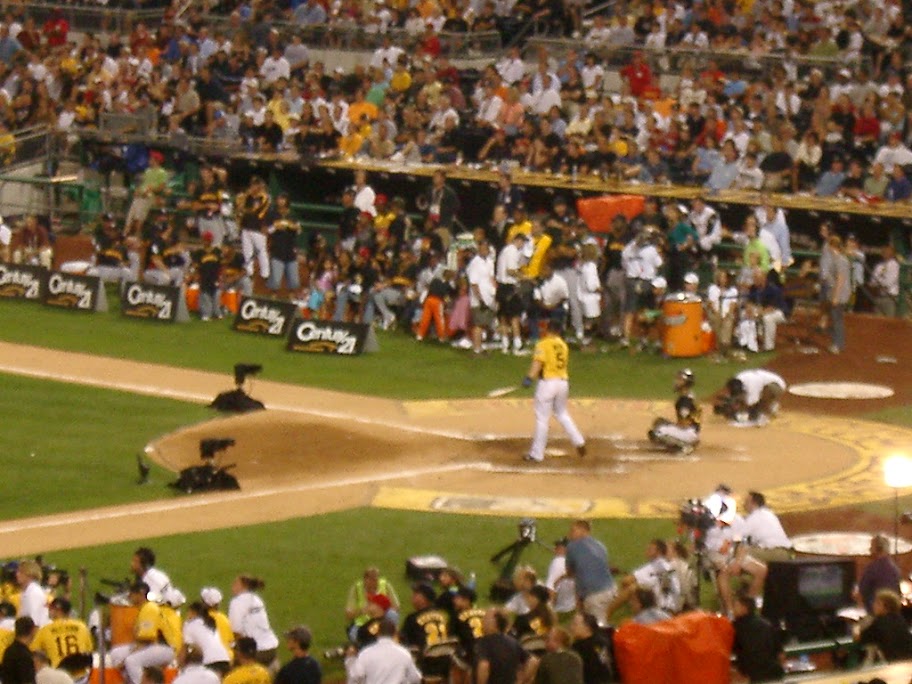
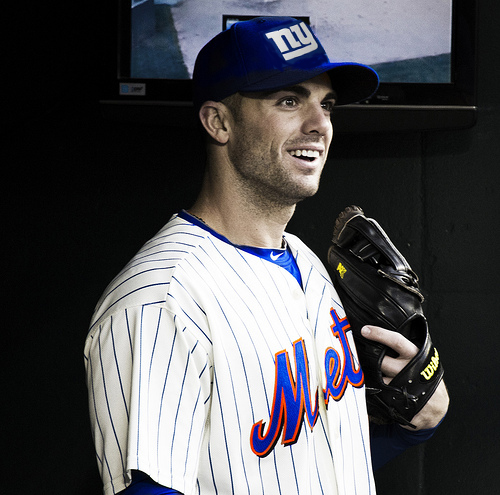
David Wright at the 2006 Home Run DerbyTholeMoley over at Mr. Met Is My Brother wrote a post about watching the NHL All-Star Game.  Actually she’s wrote a couple of them, but I want to talk about one of them specifically.  I wanted to watch the festivities this weekend, especially with John Tavares a part of them, but I had other things to deal with and missed it.  TholeMoley highlighted some of the events in the skills competition, and talks about how much better it is than the Home Run Derby.


Now, personally I like the Home Run Derby.  There is nothing more magnificent in all of sports than watching a baseball player swing and smash a baseball 400+ feet in the air.  There’s just a simple majestic beauty to it, especially if you see it in person like I did in 2006.  (And that’s not just because you can’t hear Chris Berman)  Most of what people object to about the Derby is the massive amount of time between batters and all the other stuff besides the mammoth home runs.


So broadening the spectrum might be fun and could include more than just the Home Run Derby and the random eight players they can find to participate.  TholeMoley suggests a fastest trip around the bases to parallel the fastest skater event.  She also mentions fastest players, hardest throwers, and the most accurate throwers getting their time to shine.


You could do an accuracy event.  Set up some milk bottles on a table, and have the players throw a baseball at them.  If they hit it they advance to the next round and take five steps back.  Repeat this until you have a winner.  If all players miss at the same time, simply repeat that round.


Not to take anything away from the kids that get to shag balls in the outfield, but you could position the All-Star outfielders at the walls and let them try to rob home runs all night.  Most of them clear the fence by quite a bit though.


Perhaps giving out more titles is the way to go.  In a social media society we’re all used to get badges and titles for things as simple as checking in to the ballpark more than anyone else.  Instead of just crowning a winner, crown the guy with the farthest home run, with the most home runs back to back and the guy with the highest single round total.


These are just a couple of suggestions, and none of them seem too much different than simple warm-up activities so there shouldn’t be any real concern about anyone getting hurt.  It’d be an interesting way to spice up the event and might spike interest that has been fading over the years.  There are other things they can do to, like break up the idea of National League versus American League since the advent of interleague play takes away some of the mystery of it.  It’s pretty clear that the All-Star Game is not perfect, and MLB should always be looking to tweak it.


More on Citi Field’s Uninspiring Beer List

Citi Field is a first-class venue.  It’s got amazing food, and much of it is local.  The Citi Field beer list is extensive, but it’s also uninspiring.  Beer and baseball go together so well yet most of the beers available, particularly to the general public, at Citi Field are only the typical expanded list of beers available via Anheuser Busch distribution. Some of these beers are pretty good, but it lacks that local flair and originality.  I’m not knocking the Redhook beers; but it seems sloppy to get them through Anheuser Busch when the brewery itself is only a handful of miles away. Even though they’re all over the place now, the Danny Meyer stands are New York creations.  Cascarino’s is a New York pizza place.  Pastrami on rye is a very New York food, and Keith’s burgers are especially homey.  Even McFaddens was first a New York staple.


So why was Brooklyn Brewery priced out?  Why aren’t there more Sixpoint beers around the stadium, especially now that they serve the beer in cans? What about some of the other local breweries?  Chelsea? What about Schmaltz Brewing Company which makes the Coney Island Freak line of beer. Interestingly, the Brooklyn Cyclones, the Mets rookie team, plays in Coney Island.  Maybe the Mets could serve Albino Python when the Diamonbacks are in town, or the Mermaid Pilsener to mock the Marlin’s cheerleaders.  What about Harlem Brewing Company’s Sugar Hill Golden Ale?  Harlem is where the Mets first placed, and where the Giants played before them.  Blue Point Brewery is probably the only real local beer outside of the Delta Club.  Their Blue Point Toasted Lager is available at Catch of the Day, but they’ve got other beers as well.


This all says nothing of the possibility of finding a partner to brew Mets themed beers.   Brooklyn Brewery has an expanded brewery now, and when they provided beer to Box Frites, it was their own beer called Blanche De Brooklyn that they renamed Blanche we Queens.  Why stop there?  What about a Home Run Apple Lager?  A World’s Fair Oktoberfest?  A Darryl Strawberry Blonde? The possibilities are endless. Maybe Schmaltz would be intrigued by the opportunity to create a Brooklyn Cyclones Ale for MCU Park and Citi Field.


I think the Mets, and Aramark, may underestimate just how many Mets fans are huge beer fans as well.  It’s not just the hardcore fan either.  There are plenty of casual baseball fans out there that could be drawn off the fence and into the park if they were tempted to try a unique beer.


Stay tuned, later this week I’m going to talk about what some of the other stadiums around baseball are doing with beer.

My Problems With FIP

The formula for the Sabermetric stat FIP is (13HR + 3(BB+HBP-IBB) – 2K )/ IP That’s then added to a constant to equate it to normal ERA ranges.  (xFIP  provides some extrapolation on HR rate per fly ball, but my overall concerns remain the same)


The general idea with FIP is to try to determine how well a pitcher pitches without luck and the fielders altering his results.  Once the ball leaves the bat it could be a bloop that no one reaches, or a screaming liner that happens to be right at someone.  This is not affected by the pitch the pitcher throws, and the only way a pitcher can be sure of a result is to strike out the hitter.


It’s supposed to be irrelevant to the statistic. FIP treats a screaming double off the wall the same as Jeterian soft groundout to short.  Except it doesn’t really.  The ground out is .1 IP and lowers FIP by raising the denominator in the formula.  This is part of the problem with the stat.  It does successfully remove bad defense from the equation by not penalizing a pitcher for an infield single that or a liner that finds a hole, but it also credits pitchers with good defense with extra outs.


The stat was created with the assertion that pitchers lose control of what happens after ball hits bat.  So the idea is the pitcher is ‘better’ if he can overmatch the hitter and beat him via being a better pitcher than he is a hitter, and striking him out.  Another problem is the pitcher does have some control over the batted ball, and no one knows how much or how to measure it.  You can see a pitcher one year induce a ton of soft contact, and then all of a sudden induce a lot of strong contact another year.  That’s hard to measure.  Matt Cain is one example, and Chris Young another, of pitchers that always seem to outperform their FIP.


Actually inducing soft contact, something groundball pitcher seem to do better, is something that _can_ be done.  As of yet statisticians haven’t been able to conclusively measure soft contact, and I’m not even sure pitchers can actively decide to do it with any real consistency.   It may be that the quality of contact can be reduced by keeping the hitter guessing.  Ground balls yield more outs than fly balls, but it’s also true that the times you most want to throw a pitch that gets more ground balls is also the times that the hitter knows you want to throw that pitch.


No stats are perfect, and we shouldn’t hold FIP to a higher standard, or use it in a more absolute manner, than any other stat.  I’m certainly not saying that we shouldn’t ever reference FIP, or that we should abandon the quest to expand our knowledge of baseball.


I haven’t done the math, but I could see FIP being a stat useful for picking the reliever you most want to bring into runners on situation. These pitchers should theoretically be the most likely to get an out without a runner scoring due to a lucky bloop, or a home run doing lots of damage. This is especially true of relievers because their smaller sample size of innings pitched leads to much more variance in their ERA.


The difference in ERA and FIP can also be telling, although not conclusively.  Looking to see how much a pitcher’s FIP is off from his ERA can be a way to predict if he’s getting lucky, or unlucky.  It’s not a tell-all though; it can be used as a warning flag to look further, but it’s not a direct relationship from out-performing FIP to being due for a drop off in performance.   Jonathan Niese will be a good study in this this year.  His ERA last year, as it’s been most years, was much higher than his FIP. He had a 3.36 FIP and a 4.40 ERA.  He’s rewarded for striking out a lot of guys, but the mounting data is starting to suggest that the high amount of hits he gives up aren’t just due to luck and bad fielding.


I’ve started playing around with some of the numbers, but haven’t gotten that far.  Tweaking the formula to use batters faced instead of innings pitched doesn’t make that much of a difference.  The high numbers of batters bad pitchers face tends to lower their numbers in that case.  Pitchers like Oliver Perez who face a zillion guys but then strike out the side to get out of danger would do well in that situation, but even the simplest of analysts knows that’s not a good job.


Next I tried correcting for balls in play.  Instead of simply batters faced, I removed the percentages of outs from balls in play that simple luck would turn into outs.  Then I adjusted the formula to take away extra outs the defense provided, or add back in outs they should’ve made back towards normal.   This looks better, but I’m still looking at the numbers and playing with the formulas to see if I like it.   I’m also still just trying to figure out how to smoothly create and maintain a database of baseball stats, so there is a lot of trial and error going on over here.


Sabermetrics have given us a much better understanding of baseball, but it’s only just starting.  They got there by questioning the established logic, and it’s a philosophy we shouldn’t abandon just because we’ve taken a big step in understanding.

Apparently Optimism Is Not A Sin

Ted Berg over at Tedquarters.net is doing a four part series on “If absolutely everything falls right” and looking at the upward bounds of expectations for the Mets roster.  It’s nice to know I’m not the only person looking at the optimistic avenue.  I was beginning to feel a little like Highlander as an optimistic Mets fan.


I think this post on the infield  is very reasonable, and it’s even possible that some of the players overshoot his proposed projections.   The most unrealistic part is them all staying healthy all year.  Still, health is not an unreasonable expectation.  I’m not expecting Wright to break his back again, or Ike Davis managing to fall in exactly the wrong way to ruin his season.


His second part, on the outfield, seems a tad more pessimistic to me.  Maybe Bay does rebound a little.  I’ve mentioned that here in the past, but  I think we’re doing a disservice to Duda in projecting his ceiling defensively as “not terrible”.  His outfield experience in the minors was mostly in left, and he’s only got about half a season of time in the majors.  Perhaps his hulking frame tends to make one  believe he’ll never be good defensively, but I think he can hit “not terrible” just by having all of Spring Training to start at the position and build on it as the year goes on.   He can clearly hit the baseball, and if he were to improve on what he did last year he could be our own version of Mike Stanton.  In fact, their offensive WAR on baseball-reference were very similar factoring in playing time.   Ralph Kiner and Keith Hernandez both love his swing, for whatever that’s worth.


Ted dreams of Jason Bay having a great first half and becoming a trade chip and Kirk Nieuwenhuis forcing his way up to the majors.  Personally I think that’s unrealistic, because I don’t think a half season of good baseball is going to yield the type of return to make it worth trading him.  He’s not Carlos Beltran and his trade would come along with 24 or so million dollars owed to him and a possible vesting option.  More likely if Nieuwenhuis does warrant a call-up, Andres Torres will become a fourth outfielder.  If this happens we’ll lose a little defensively, but gain a lot offensively, including some flexibility with defensive replacements.


So what’s the highest fWAR we can expect from the Mets offense?  I’m going to say somewhere in the 28-30  range.  This would’ve had them 4th in the NL last year and best in the NL East.   I think this number represents of everything goes well.  It’s certainly possible that if one or two things turn out to go extraordinarily well, they could shoot past it.  Because fWAR heavily relies on fielding, if the pitching does better there will be less balls in play and less fielding damage to the values.  I assume part three and four of Ted’s series will deal with the rotation and the bullpen.

Around Metsopotamia: Links Galore!

First up, Daniel Murphy!


Mets Infielder Daniel Murphy To Be Honored With Inaugural “Rising Star” Award At Thurman Munson Awards Dinner On Tuesday Night, January 31, At Grand Hyatt Hotel

***Joins Teammate R.A. Dickey, Yogi Berra, Mark Teixeira, Chris Mullin and Dikembe at Benefit for AHRC New York City Foundation***

New York, January 19—New York Mets infielder Daniel Murphy will receive the inaugural “Thurman Rising Star Award” at the 32nd Annual Thurman Munson Awards Dinner on Tuesday night, January 31, at the Grand Hyatt Hotel in New York City, it was announced today by AHRC New York City Foundation.

Murphy will be cited for his perseverance in returning from injury and for his community spirit and involvement in a wide variety of Mets community programs, particularly in reading for youngsters and the military. The 26-year-old Jacksonville, Florida native hit 313 in his rookie season in 2008 in limited action, and a torrid .320 last year. Murphy has battled several knee injuries since joining the Mets, and is a second base hopeful in 2012.

Murphy joins Yankee Hall of Fame icon Yogi Berra, Yankees first baseman Mark Teixeira, Mets pitcher R.A. Dickey, St. John’s/N.B.A. recently inducted basketball Hall of Famer Chris Mullin, and Georgetown/N.B.A. star center Dikembe Mutombo as this year’s honorees.

The gala, which remembers the late, great Yankees catcher and captain, benefits AHRC New York City Foundation.  Berra will receive the Legend Award in celebration of the 50th Anniversary of the 1962 World Champion Yankees, while Mutombo, Teixeira, Dickey and Mullin will each receive “Thurmans.” For tickets and information on the Munson Awards Dinner call 212-249-6188.

Diana Munson, Thurman’s widow, will attend her 32nd straight benefit, having been involved since its inception, raising nearly $11 million to assist children and adults who have intellectual and developmental disabilities. The Thurman Munson Awards are presented for success on the fields of play and philanthropic works off the field.

The AHRC New York City Foundation is a not-for-profit organization that supports programs enabling children and adults with intellectual and developmental disabilities to lead richer, more productive lives, including programs of AHRC New York City.  AHRC New York City is one of the largest organizations of its kind, serving 12,000 children and adults who have intellectual and developmental disabilities, including autism, cerebral palsy, traumatic brain injuries and other disabilities.


Second up? The Mostly Mets Podcast! Patrick Flood, Ted Berg, and Toby Hyde do a great job with their weekly podcast.  I usually plug it into my car radio and get to avoid a day or two of hoping the local radio stations are talking about something worthwhile while driving to and from work.  They released the latest episode yesterday afternoon.  One of these days I’ll write up a formal review.


Kerel Cooper at On The Black chimes in with his expectations for Jason Bay.  If you recall I tried to find some optimism along that front recently.


If you haven’t read R.A. Dickey’s posts in the Times about his climb of Mount Kilimanjaro…well, I’m really not sure why you wouldn’t have read that already, but here it is again.


To follow me on Twitter, go here.  To leave feedback on this post, this blog, a recent craft beer you’ve had or to request Ceetar on your internet radio show, drop me an email at ceetar@ceetar.com

Are the Mets Irrelevant?

Joe Janish at Mets Today declares the Mets irrelevant.  The preliminary ESPN Sunday Night Baseball schedule came out, and the Mets are not on it.  Of course, the schedule only lists 10 of probably 26 or so total games, but certainly no one at ESPN thinks the Mets are going to be a draw early on.


He then asks at what point between the Mets signing Pedro Martinez and yesterday did the Mets fade into oblivion?


I think that date was when Jose Reyes signed with the Marlins.  The Mets losing their homegrown star, who’s one of the most exciting players in baseball, and seemingly fading into a financial holding pattern, was a big blow.  ESPN likes to air flashy stars and lots of drama.


This doesn’t mean the Mets won’t be on ESPN though.  There are certainly parts of the Mets that can turn into compelling stories.  ESPN would love to see a resurgent Johan Santana face Roy Halladay for instance.  If the Mets were competing with the Marlins later in the season, ESPN would love to twist the knife with the Reyes at Citi Field game.   The Subway Series could get flexed to prime time.  If Ike Davis and Lucas Duda are blasting home runs, it could propel the Mets into a interesting story.


ESPN’s opinion on what is a draw is also high skeptical.  A Spring Training beaning of Chase Utley by Mike Pelfrey and an ensuing fight could be enough to prompt them to put the first Sunday Mets-Phillies game on.    Still, the Mets are clearly underdogs in not just the games but in attention.   If they want to be a respected or interesting team, they’re going to have to earn it.


2012 New York Met as 2011 New York Giant

Every year there are tons of examples of teams that were deemed to have no chance to be competitive that make surprising runs deep into the playoff rounds and sometimes win it all.  The New York Football Giants were given very little chance to make the playoffs, and even less once they started piling up injuries in the preseason.  Tom Coughlin’s job was in jeopardy nearly every week, and Eli Manning was laughed at for calling himself elite.  The Giants were soundly criticized for mismanaging the cap and for doing nothing in the offseason.


Now there are only four teams left.  One of them is the Giants, and no one’s doubting they have a serious shot at winning their game in San Francisco and going to, and perhaps winning, the Super Bowl.


Eli Manning won Super Bowl MVP in 2008 in Super Bowl XLII.  That vindicated him some from the critics early in his career, but his failure to win a playoff since had brought back the doubts about his talent.  Last year he had a lot of interceptions, and it really downgraded his status with a lot of people.   In a way, it reminds me of David Wright.


I have hope that the 2012 David Wright will be a similar story to 2011’s Eli Manning.  David’s strikeouts nicely represent Eli’s interceptions.  Although he doesn’t have a title, Wright was a legitimate MVP candidate in 2007.  In 2012 I expect to see Wright return to that form.  After Eli outplayed Aaron Rodgers on Sunday there were people that were even comparing him to his brother Peyton, who may be the best ever.   When the 2012 MLB season ends, no longer will we have to debate if he’s the best third baseman in the NL East.  Instead critics will struggle to find a third baseman in all of baseball as good as he is.

Other Citi Field Changes?

Last spring we were faced with the shocking news that Brooklyn Brewery beers would no longer be available at the Shake Shack stands out in center field.  Every season at most stadiums things change from season to season.  Usually they’re small things; advertisers change, menus get tweaked, music changes and mid-inning contests are different.  Maybe there’s a new dunk tank, a home run apple, or a new banner or piece of memorabilia celebrating the home team.


This season the Mets are making major structural changes to the dimensions and height of the wall.  This won’t have any real affect on the win-loss record, but it’ll probably create more home runs for fans.  At least it’ll create a different seating area that should be interesting.


So what smaller changes can we expect at Citi Field this summer?  The easy one is that Keith’s burger stand will probably become a permanent fixture somewhere and we’ll get some new test product in that space.   Citi Field has an extensive beer list, but what it lacks is local community beers.  While on a Citi Field food tour last season, I was told that some of the concessions were chosen because of their local affiliate.  Cascarino’s is so close that if you called them up and gave them Citi Field’s address, it’d fall within the delivery zone.   Hopefully they’ll take this into account when looking at the beer available next year.  The only local beer outside of the Delta Club was Blue Point’s Toasted Lager at Catch of the Day.  Great beer, but not enough.  Nor is the couple of places you can get Brooklyn Lager.  It doesn’t have to be the perfectly paired beer for Shake Shack, Blue Smoke, or El Verano Taqueria even though it should be.  A handful of craft beer booths around the stadium would work just as well.  Plenty of people in New York love their craft beer and want to drink something more than Budweiser at a baseball game even if Anheuser-Busch is going to brand the cans with a Mets logo this year.


Ommegang is a New York brewery from Cooperstown.  There should be a tap of beer from there in every stadium across the country in my opinion.  There’s already some in the Delta Club, so why not make it available to all?   I bet it’d be possible to get Brooklyn Brewery, or a different local brewery, to contract-brew specific beers for the Mets.  How cool would it be to be able to get a Tom Seaver Ale, a World’s Fair Unisphere Rye, or a Home Run Apple Cider?

2012 Mets: The Big Tease

How’s that for a slogan?  This was inspired by the Mets tweeting pictures today of Johan Santana throwing in Port St. Lucie.  It was good news in the sense that his arm didn’t fall off, but throwing in January tells us little about what he’ll do in April.


It’s still over a month until pitchers and catchers report, and closer to three until the first real game.  I’m thankful for the Mets sharing these types of things, and love seeing Johan on a baseball field, but ultimately this is a big tease.   There’s still plenty of uncertainty with how Santana’s shoulder will hold up to a full Spring Training and following that, the season.


In a way the whole  2012 Mets season may be a tease.  With the finances and roster turnover it very much feels like the Mets are in a holding pattern.  That’s not to say things won’t ultimately turn out good, but there are plenty of question marks we need answers to and a lot of time before we can start finding them.  2012 may be one long quest to find the answers.  What do we really have in Lucas Duda, Josh Thole, Ruben Tejada and Ike Davis?  To what extent can David Wright and Jason Bay rebound?  Are any of the touted pitching prospects going to be knocking on the rotation door for 2013, or sooner?  Is second base the anti-matter to Daniel Murphy‘s matter, causing explosion whenever they come in contact?


Stay tuned, because 2012 may be the big tease before we find out where this team is going.

CRG and Fred Wilpon Don’t Affect Me

I saw this post over at Mets Police about the CRG situation and how fans will root for this team this year.


It’s interesting how people sometimes forget that peoples positions, viewpoints, or situations change.  The idea that the Mets hiring CRG could mean they might file for bankruptcy and one day have to sell is not mutually exclusive from the Mets statement that they didn’t hire CRG to file for bankruptcy.
The same was true of the original Mets statement that the Madoff situation would not affect the Mets.  It’s easy to look back now and accuse them of lying, but the situation probably spiraled beyond what they expected, including the contining poor economy to the reach of the Picard lawsuit.  You could say perhaps it was just short-sighted and that they should’ve known it was going to affect the team, but I’m not so sure that’s the case either. If the Mets had not gone into a downward spiral themselves and instead had won games, stayed healthy, and been competitive there is a chance they would’ve remained profitable.
If you want to read into every statement and play conspiracy theory that’s fine.  Chances are there are stuff Fred Wilpon is glossing over and stuff he’s flat out ignoring.  He could even be lying about certain things.  We’re not obligated to know everything about the behind the scenes investments or have access to all financial statements of the team we root for or the owners of that team.  No one’s doubting that the current financial situation around the Mets is bad, cost us Jose Reyes, and looks dire. Still, hiring CRG was actually a positive move.  It’s not a “Hey look at the embarrassment this team is” move, it’s one aimed at getting the team righted.
CRG was _not_ hired by Sterling or the Wilpons, and the negative revenue situation does not go away with a new owner.  In the same breath people are criticizing the Mets for spending wildly to get themselves into this mess, and criticizing the Wilpons for being too broke to spend wildly to try to get the team out of this mess.  Some question who would want to be a minority investor in this team, but isn’t it also a valid question to ask who would want to buy a team that they’d have to put tens of millions of dollars into each year?  Remember they lost 70 million last year.  You can see value in the future of this team as both a minority or majority owner if you look.
You’re welcome to not spend money on the team if you want. The Wilpons won’t see a dime anyway, no matter what you spend, since the team is losing money. Winning solves the Mets problems, losing exacerbates it.  Nothing you do will change that.  If you can give up the enjoyment derived from going to see a game, that’s fine.  Just remember you’re also withdrawing your support from Ike Davis.  David Wright will notice when he hits a walk-off grand slam and there are only 12 people cheering.  Do you think he’ll remember that when he becomes a free agent at the end of one of the next two seasons? Did Jose Reyes notice how empty it was in front of his supposedly loving fans in September while he was chasing Mets history?
Some people phrase it as “Choose the Mets, not the Wilpons”. To me that means enjoying Mets baseball whenever I can get it and not worrying about who the owner is.  I derive no joy from who owns the Mets, or who runs the Mets.  All I keep thinking is that if the Wilpons selling is so important to you, you’d almost have to be disappointed if the Mets went on a miracle run and went to the World Series, because the resultant cash flow could cement them as owners.  So I’ll stick to hoping for that miracle run and let the financial stuff shake out where it may.