
Give Me Factual Arguments, Not Boasts About Being Right

With over a month left of baseball it feels like a lot of people have already made up their minds about what the Mets should do.  Not only with the rest of the season and who gets playing time, but what they should do in the offseason and who should be the front runners for spots in 2013.  There is a lot of time to worry about the offseason, and the remaining games will still tell a lot about the Mets.  If we’re going to get a real sense of what’s going on this offseason, it’s important to pay attention to these next 39 games in addition to the ones we’ve already seen.


It’s so easy to jump the gun in today’s society of instant-reaction.  We’re in such a rush to be first to a topic, or to be correct in analysis, that we often run roughshod over facts and data to shout to the world that we told it so.   The Mets record sinks, or rises, to what we thought it would be and we’re quick to point out that it’s what we expected.  We’re silent two weeks ago when Andres Torres was hitting the ball and had a league average OPS+, but now riding a pretty bad slump we’re quick to call for Sandy Alderson to non-tender him in the offseason, despite the possibility that he could hit .350 the rest of the season and have very respectable numbers.


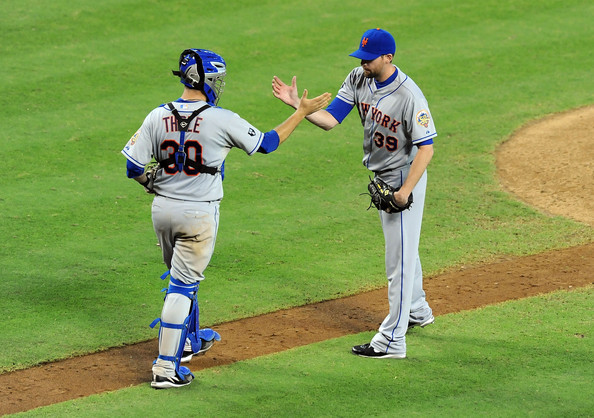
This week’s storyline is that the Mets have quit playing hard, even though there are still 39 games left.  They could go a rather pedestrian 21-18 and still finish better than last year.   The Mets fundamentals have been sloppy all season.  They’ve failed to advance on the bases, they’ve made bad throwing decisions, taken bad at-bats, and let balls fall in front of them that they got a bad jump on.  Simply put, they’re not real good in the field.  Them continuing to do these things is not indicative of effort but of talent.   On top of that, the other teams have learned that the Mets won’t throw them out at home.   That know they can expect the balls to drop in and be ready to take the extra base.  The scouting reports suggest that Josh Thole is not going to nab them at second if they get a good jump.  In the second half of the season teams take advantages of the weaknesses they saw in other teams in the first half while trying to patch their own.  The Mets failure to do this was a reflection of the talent level, roster depth, and injury, not one of how much they respect their manager.  Despite being four games over .500 on July 29th last year, the Mets fell to eight games under on August 23rd in less than a month and still played .500 baseball from that point forward.


The problem here is that the current state of the Mets is how they’re going to be perceived until the 2013 season starts.   Excepting the true die-hards most fans (and the media that’s going to be writing season recaps stories and season preview stories next year) will be refocusing some or all of their attention to other things.  There are plenty of pennant races going on elsewhere, the traditional television schedule starts up soon with new shows, the NFL starts it’s schedule pretty soon and kids go back to school and life moves on, leaving the Mets to play out the string with very little true analysis of what’s going on.  Even if the Mets win 22 of their last 39 games, they’ll be remembered as having gone into a tailspin in the second half.  Ike Davis, who’s had a good second half, could get his on base percentage over .300 and that’ll be quite an accomplishment, but his season will be remembered for the horrible start and when people look at his overall stat line, it won’t reflect the hard work he’s put in.  When everyone else around him was struggling to make second half adjustments, Davis did and the results are there if you look for them.


There is no prize for predicting how events were going to turn out in sports or how individual players would perform.  More important is thinking about why things turned out that way, what could have been done to fix it, and what are some of the ideas to make sure it doesn’t happen again.  “I told you Jason Bay sucked” is not analysis, and following it up with “Andres Torres sucks too, non-tender him” does not carry more weight because you were right about Jason Bay.


Here’s a piece of advice going forward:  Try making a coherent argument against what you believe.  If you think Ruben Tejada is a solid contributor for 2013, look up his baseball-reference page and try to come up with an argument for why the Mets should look elsewhere for a shortstop.   Then read your argument and see if it sounds believable.  If it doesn’t you probably aren’t making a thorough enough argument, because in baseball it’s pretty easy to make a case for the success or failure of most players.  It’s a game of percentages and probabilities.  Even perennial All-Stars have negative things to look at and pitfalls to worry about, but the chances that the things in the positive column happen are way more likely than the negative.  With other players the chances are smaller.   Ruben Tejada’s batting average on balls in play is pretty high, he’s walking less than less year and striking out more.  Those are all notable things and the chances are high that that some of his hits he’s been getting will stop finding holes and become outs.  That argument is, probably, out-weighed by the high line drive percentage and the increase in doubles.  It’s easy to look at both pieces of information and conclude that you think the chances are better that he’ll continue seeing the ball well and hit it hard for more doubles, but without the context of the batting average on balls in play and walk rate, it’s hard to guess what will happen the next time Tejada has a little slump.


With so much information and so many stats out there, it can be pretty easy to find something that supports your preconceived notion of what you think of a certain player or team.  It’s important to stop worrying about trying to prove what you think and try to get a truer sense of what’s actually going on.  Because nothing’s more believable than a well-reasoned factual argument.

The Re-Sign Ronny Cedeno Campaign

Everyone knows about Kelly Shoppach and Scott Hairston and how they both could help the Mets next year if they’re re-signed, but Ronny Cedeno is not getting enough love.


Ronny Cedeno is the backup middle infielder and has gotten 140 plate appearances this season.  He’d probably have more if he hadn’t had a brief DL stint.  He’s got an .822 OPS with a .367 OBP.   Of Mets with 100 at-bats, he’s 3rd in OBP behind David Wright and Mike Baxter, and Scott Hairston overtakes him in OPS due to his awesome slugging.   Ignoring the obvious problem of having three part time players out-performing most of the regulars, Ronny Cedeno would be a really useful player for the Mets next year.


He’ll only be 30 next year and plays the middle infield positions pretty well.  He hits right-handed which is useful for the Mets if they continue to have a pretty lefty-heavy team.   He’s not really a stolen base guy (hasn’t attempted one all year) but he’s not slow.  He’s not really a power guy, but you can live with that from the backup in the middle infield, and he does have three in limited time this season.


Certainly he’s having a career year, and it’s been so few at-bats that it’s hard to rule out it being anything but luck, but he has increased his walk rate by over 4% to a very good 10.7% and raised his extra base hit percentage.  This seems to reflect the not swinging at bad pitches and waiting for ‘your pitch’ that has been Dave Hudgen’s philosophy.  His swing percentages are down, also suggesting he’s laying off balls and unhittable pitches.   So perhaps he really has learned something in New York, even if his .455 slugging percentage is probably unrealistic.


Given the option of believing Cedeno has made progress at the plate versus looking for another guy to fill that role that we hope can contribute, I’d definitely like to keep Ronny here next year.

On Wishing Johan Santana into the Cornfield

The talk lately has been whether or not the Mets should shut down Johan Santana for the season.  He’s been mostly ineffective lately, and there is a growing concern that he’s hit a wall with all the rehab and work he’s put in to be healthy this season.  No matter what you or I think, the Mets and Santana have a lot more knowledge of the situation than we do.  There is probably no clear and obvious answer here even for the Mets, and especially not for people outside the situation, which includes the media.  The media are writers and reporters, not doctors.  They’re as unqualified to speak on the right course of action as they were to speak on the state of the Mets finances.  Take their info on how Santana is feeling and what the Mets are saying about it, but their prescribed course of action is not necessarily the best one.


Personally I’d err on the side of keeping him pitching.  At least until he throws a good game or two.  This is all presuming that there isn’t some unseen or unreported injury, but recovering from a serious injury to perform at the top level of your craft is hard, tenuous work.  Throughout his life Johan Santana’s arm has been what’s separated him from his peers, it’s what makes him special.  To have that arm give out on you so seriously can be crushing.  I imagine that feeling has been in the back of Johan’s mind all season.  The same is true of any injury; if you hurt your foot even days after you feel no pain you still often step tenuously because you expect it to hurt.  Johan Santana has all the same doubts floating through his head that we do about the durability of his shoulder and whether he’s the same pitcher.  So on that note, I think it’s valuable for him to get through this period the same way any pitcher wants to get through the valleys inherent in every season.  It’s important for him to dismiss the doubts that his shoulder is failing him and allow it not to be the undercurrent of every outing he has next spring.  Reaffirm that hard work will get him where he needs to go, and then shut him down.


I do think there could be some value in getting Johan Santana an extra week or two off this offseason by shutting him down in September once he’s hopefully bounced back from this stretch.  The Mets might like to get a start or two out of prospects like Colin McHugh or Jeurys Familia and Santana’s spot would be one way to do that. After all Johan Santana has given us as fans, particularly the no-hitter, it’d be nice to see him go out this year on a high note.

Release Jason Bay! Unless…

There are very very few people that think Jason Bay should be in the plans for the 2013 Mets.  I’m not even convinced Jason Bay thinks it.   On the other hand, the Mets need outfielders and Jason Bay technically qualifies as such.


He hit a home run last night which I believe brings his SLG up to .297.  Luis Castillo is a better slugger than that.  I truly believe the concussions may have had a huge effect on Jason Bay and that he’s still not right.  There’s so much we don’t know about concussions and the things you need to do to be a successful baseball player require a level of focus and reaction time that is based in the brain.  Reasons and excuses aside, the question remains as to whether Jason Bay has any chance at returning to being a capable major league outfielder, and if he can do so by early 2013 for the next time the Mets expect to play games that matter.


The time remaining in this season is not substantial, but it’s just enough to plant the seed of hope.  So I ask you, what can Jason Bay do in the remaining games on the schedule to make you believe their is a chance he can contribute next year.   I’m not asking for you to be convinced the Mets should keep him around, just what it would take for you to think “Maybe he can be a Scott Hairston next year..” and believe it.  10 home runs?  20?  An OPS of .900 the rest of the way?  Watching him consistently identify and crush bad pitches?


Remember that the Mets currently have pretty much none of their outfield spots set in stone for 2013, so the floor to make this team is theoretically pretty low.  Is it Jason Bay low?  Answer in the comments or tweet @ceetar.

The Second Half Swoons

So why the second half swoons? What has befallen this Mets team that’s kept them from playing as good baseball as they played the first half?  Why does this seem to be a theme, year to year?


I wrote about the Mets margin of error a month ago, and they haven’t played much better since.  I think this plays in to the second half; when it’s time to make adjustments and tweaks for the second half, the Mets haven’t done so.  Part of this is lack of depth for sure, the Mets in recent years haven’t had enough players to cover injuries, sometimes guys having strong starts don’t adjust when the league starts adjusting to what they’re doing.


The Mets were playing the line between winning and losing so close that a couple of adjustments, injuries, or slumps ended up ruining their season.  Such as when David Wright stopped hitting for two, or when Dillon Gee went down.  I think Gee’s blood clot in the shoulder may have been more demoralizing than people think.  It’s one thing when a teammates hurts himself giving it his all on the field, but to come up with a sudden medical malady?  I could see how that could jar you out of the competitive nature of a game when life interjects.  Nieuwenhuis stopped hitting, Duda struggled and even Davis didn’t ride out the hot streak long enough to make up for his bad April and May.


The Mets played very well in June, but I might make the case that they underperformed.  They had one of the best pitching staffs in June, with R.A. Dickey doing historic things, and managed to lose a couple of games they probably should’ve won.  The bullpen was not horrible in June either.   Perhaps if they’d gone into the All-Star Break a couple of games better they would’ve come out of it with a different attitude and focus and maybe would’ve fared differently.  Maybe not.


It seems clear to me that the good teams made adjustments and the Mets either didn’t have the talent, ability, or preparation to make counter adjustments.  They got hit with good teams coming out of the break and ended up getting knocked out.   Some of it’s injury and depth.   Kirk Nieuwenhuis is a good example of this.  Perhaps if Andres Torres has stayed healthy, Kirk would’ve come up in July instead and he’d have added an offensive jolt at that time instead of tailing off.  The Mets had no other outfielders to call up as Jason Bay, Nieuwenhuis, and Lucas Duda struggled.  They had no counter-attack.  They had options in the bullpen, but those options ended up being almost as ineffective as the guys they replaced.


The Mets had some talent, but it turned out that more of the flaws caught up with them than talent shining through.  With just one or two players having a little big more impact, it feels like the Mets might have weathered the storm.  Having the Kirk Nieuwenhuis of April and May over the Jason Bay of July and August almost seems like it might have been the difference between the 77 win Mets and the 87 win Mets.   This is definitely over-simplifying it, but perhaps the Mets are only a couple of adjustments away from being consistently good.  It’s certainly going to be an interesting offseason to see what adjustments the Mets end up making.  There’s a lot of baseball still to be watched this season, and some of these guys may be playing for a job next year.

Ticket Winner

The winner of the two seatcrew.com, the no-fee ticket marketplace, tickets against the Rockies was Chris Sakmann.  Have fun Chris!  Glad it came in a win.


The next opportunity to win tickets will be around the second weekend of September, so keep an eye out.


August Ticket Giveaway: How Many Hits?

It’s time again for a ticket giveaway, courtesy of seatcrew.com, the secondary ticket marketplace with no fees.  This time you have a chance to win two tickets to the Mets game against the Colorado Rockies on Monday August 20th.   Right now that’s lined up to be an R.A. Dickey start.


To qualify, you must register an account on seatcrew.com and follow them, and me, on Twitter and then correctly guess the answer to the following question.


How many hits will the Mets get against  Ben Sheets and the Braves this Sunday night?


The closest answer that is equal to or greater than the actual amount of hits the Mets get wins the prize.  This means it’s better to be optimistic and go over than have the Mets outhit your guess.  In case of a tie, tell me how many of those hits will be David Wright’s.


Answers must be submitted before first pitch on Sunday night, August 12th to
contest@ceetar.com

The Bridge Between Hope and Elimination

There are often two extremes to any situation.  One side will tell you the Mets playoff hopes are over, while the other might say they live on until the Mets are mathematically eliminated or at least further than 7 out with 17 to play.   Right now we’re bridging the gap between the two in a murky cloud where the Mets try to grasp at the last tendrils of hope before they flutter away.


53 games to play is a lot of games left in front of the Mets on the season.  With that many games left the Mets are still chasing a number of wins more than a Wild Card leading team.  After all, the team that’s leading today might not be the team that wins, meaning you’re not quite as far behind as it looks.  It wouldn’t even take a collapse to drop the number needed to qualify for the postseason to 88 wins, just a less than awesome second half by a couple of teams.  Currently the team occupying the low end of the playoff spectrum in the National League is the Pittsburgh Pirates with a 93 win pace, followed by the Cardinals with an 89 win pace.  There isn’t enough hope to bet on, but perhaps there is just enough to fill a dream.


The Pirates have not had a winning record since 1992, as pretty much everyone is aware of these days.  The Pirates have long been held up as the example of the team you’re supposed to beat on the schedule.  The Pirates have not won a postseason series since 1979, which was before I was born.  Is it impossible that a Pirates team that won less games than the Mets last year falters a little in the second half? Andrew McCutchen may be the best player in baseball this year, but can he sustain this incredible pace all the way to the end and if he doesn’t can the Pirates  compensate for the drop in offense?  Look at the Mets since David Wright stopped batting .350.


It’s worth taking a moment out from my point here to suggest you take the opportunity to watch McCutchen if you have a chance.  He’s having an amazing year.


Even if 88 wins is the mark the Mets need to get to, they’d need to play to a 35-18 record the rest of the way.   That’s quite a record, but it’s not an insurmountable one.  It would require some very good baseball, quality baseball that the Mets have no sustained for that length of time all year, but it wouldn’t be the most shocking thing in the world if it happened.  The schedule works in their favor too, as they’ll be able to affect the wins and losses of some of the teams they’re chasing, including the Braves, Pirates, and Cardinals.


Time however, is not on the Mets side.  If they’re going to make a run it has to be now.  The last remnants of hope lurking in the recesses of the Mets season will be cleaned out and packed away for next year of the Mets don’t start a serious winning streak over the next week or two.   Winning road trips or home stands are no longer enough.  They need to win series and mix in a sweep or two.  Until then, the Mets exist in this murky state where you know they can get back into the hunt but you can’t quite see the path they’d have to take to get there.

The Mets Best Reliever

July 28, 2012 - Source: Norm Hall/Getty Images North AmericaEveryone likes to toss out the Mets bullpen ERA and talk about how bad it is and call it the worst bullpen ever.  Truthfully though, the Mets do have some good relievers and they’re getting overshadowed by how bad the overall numbers look.


Tim Byrdak and Jon Rauch have both had pretty good years, give or take a couple of slumps, but it’s Bobby Parnell I want to talk about.   ERA is not everything, but Parnell’s is at 3.07 which certainly isn’t bad.   Parnell has actually been better than that though, he’s just been victimized by some bad luck and defense.  Four of the 19 runs scored against him are unearned.  That’s more than 20%.


Since Frank Francisco last pitched for the Mets, Bobby Parnell has pitched 14 innings and allowed 4 earned runs for a 2.57 ERA and a .581 OPS against with 15 strikeouts.


He’s holding opponents to a .354 slugging.  Luis Castillo’s career slugging was .351.  So Bobby Parnell is as likely to give up an extra base hit as Castillo was to hit one, and you may recall that didn’t happen very often.


He’s been victimized by the Mets not turning double plays.  The MLB average is 11% of  ground balls with a runner on lead to a double play.  The Mets only turn 6% of them for Parnell.


Parnell strikes out 23.4% of the batters he faces, which is well above the MLB average of 18.4%.


He walks 5.7% and the MLB average is 8.5%.


His ground ball to fly ball ratio (with line drives included in fly balls) is 1.38 compared to the league average of 0.8.


His first pitch strike percentage is above average, as is his swinging strike percentage.  He throws more total strikes than the average reliever and gets to a 3-0 count less often.


With runners on third and less than two outs the runner scores only 36% of the time against Parnell as compared to 52% league-wide.


So Parnell has actually executed his pitches pretty well and should be getting better results.   Games like Jordany Valdespin’s two error game at shortstop make his numbers look worse overall, and double plays not turned have hurt him, particularly because those don’t count as errors because you can’t assume the double play, and ultimately hurt his ERA.   Given his strikeout numbers and the fact that he rarely allows extra base hits and home runs, Bobby Parnell is the reliever you most want on the mound in any given high-leverage situation.